


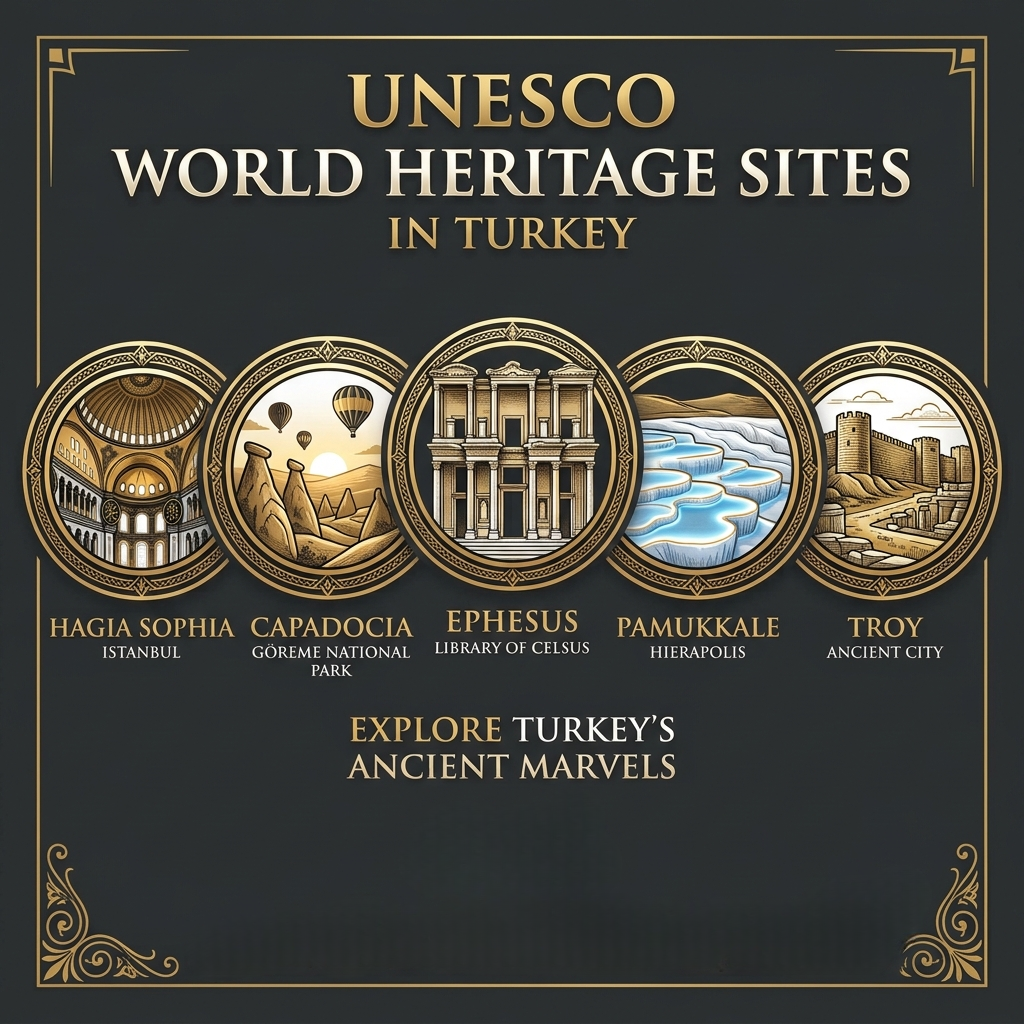
Situated at the crossroads of Europe and Asia, Turkey (Türkiye) has served as the cradle for some of human history’s most influential civilizations. From Neolithic hunter-gatherers and bronze-age Hittite kings to ancient Greek philosophers, Roman emperors, Byzantine scholars, and Ottoman sultans, countless cultures have left their indelible marks upon Anatolia.
Today, Turkey boasts 21 officially recognized UNESCO World Heritage Sites, spanning tens of thousands of years of human achievement, architecture, and natural wonder. Here is a comprehensive guide to the most iconic UNESCO World Heritage Sites across Turkey.
1. Göbekli Tepe: The World’s Oldest Sanctuary
Located in Southeastern Anatolia near the city of Şanlıurfa, Göbekli Tepe rewritten human prehistory upon its discovery. Dated to approximately 9600 BCE, this monumental sanctuary pre-dates Stonehenge by over 6,000 years and predates the invention of pottery, writing, and the wheel.
Key Highlights
- T-Shaped Pillars: Massive limestone monoliths reaching up to 5.5 meters tall, carved with intricate bas-reliefs of wild animals including foxes, scorpions, lions, and vultures.
- Revolutionary Significance: Proved that complex ceremonial architecture was constructed by hunter-gatherer societies before the transition to settled agriculture.
2. Göreme National Park & The Rock Sites of Cappadocia
A mixed World Heritage site recognized for both natural beauty and cultural significance, Cappadocia features a surreal landscape sculpted by volcanic activity and millennia of wind and rain erosion.
Key Highlights
- Fairy Chimneys: Spire-like rock formations carved into dwellings, monasteries, and underground cities.
- Göreme Open Air Museum: Features subterranean churches (such as Karanlık Kilise / Dark Church) adorned with vibrant Byzantine frescoes dating back to the 10th to 12th centuries.
- Underground Cities: Multi-level subterranean refuges like Derinkuyu and Kaymaklı that once sheltered thousands during times of invasion.
3. Ephesus: The Crown Jewel of Antiquity
Nestled near the Aegean coast, Ephesus was one of the largest and most prosperous cities of the Classical world, serving as a key Mediterranean port and the Roman capital of Asia Minor.
Key Highlights
- Library of Celsus: A stunning two-story Roman facade built to house over 12,000 scrolls and serve as a monumental tomb for governor Celsus.
- The Great Theatre: An open-air theatre capable of seating 25,000 spectators, famously referenced in early Christian history during Saint Paul’s travels.
- Temple of Artemis: Though only a single reconstructed column remains today, it was celebrated as one of the Seven Wonders of the Ancient World.
4. Historic Areas of Istanbul
As the capital of three successive empires—Roman, Byzantine, and Ottoman—Istanbul holds a concentration of world historic architecture. Inscribed as a UNESCO site in 1985, the historic core spans four distinct zones:
- Sultanahmet Archaeological Park: Home to the Hagia Sophia, constructed under Byzantine Emperor Justinian I in 537 CE, renowned for its massive dome and gold mosaics; the Blue Mosque (Sultanahmet Mosque); and the historic Hippodrome.
- Topkapı Palace Quarter: The sprawling seat of Ottoman power for over four centuries, overlooking the Bosphorus and Golden Horn.
- Süleymaniye Mosque Area: Designed by the legendary Ottoman imperial architect Mimar Sinan in the 16th century.
- Theodosian City Walls: The ancient defensive fortifications that protected Constantinople for over a thousand years.
5. Hierapolis-Pamukkale: Travertine Terraces & Thermal Baths
Located in Denizli Province, Pamukkale (“Cotton Castle”) is a natural and historical wonderland where mineral-rich thermal waters cascading down hillside terraces have created white travertine basins over centuries.
Key Highlights
- The Travertines: Glowing white terraces filled with warm, mineralized springs.
- Hierapolis Ruins: An ancient Greco-Roman spa city featuring a remarkably preserved ancient theatre, a grand necropolis, and the restored Antique Pool (Cleopatra’s Pool), where visitors can swim among submerged Roman columns.
6. Nemrut Dağ: The Tomb Sanctuary of Commagene
Rising 2,134 meters high in eastern Turkey, Mount Nemrut is famous for the monumental sanctuary built by King Antiochus I of Commagene in 62 BCE.
Key Highlights
- Colossal Head Statues: Massive stone heads representing Antiochus alongside syncretic Greek and Persian deities (Zeus-Oromasdes, Apollo-Mithra, Heracles-Artagnes).
- Celestial Alignments: Designed to frame sunrise and sunset over East and West terraces, creating a dramatic landscape against the Anatolian skyline.
7. Çatalhöyük: Early Urban Settlement
Dated to around 7400 BCE, Neolithic Site of Çatalhöyük in the Konya Plain provides an unprecedented window into early human transition from nomadic hunter-gatherer life to permanent agrarian society.
Key Highlights
- Streetless Architecture: Houses built adjacent to one another without streets; residents entered dwellings via ladders through rooftops.
- Early Art and Spirituality: Wall paintings, figurines (including the famous seated Mother Goddess), and interior plaster reliefs of bull heads.
8. Archaeological Site of Troy (Troia)
Immortalized by Homer’s Iliad, Troy in northwestern Turkey represents 4,000 years of history across nine distinct archaeological layers (Troy I to Troy IX), bridging myth and documented antiquity.
9. Hattusha: Hittite Capital
Located in Çorum Province, Hattusha was the royal capital of the Bronze Age Hittite Empire, which rivalled Ancient Egypt in power. The site features imposing stone gateways (such as the Lion Gate and Sphinx Gate), cuneiform archives, and the nearby rock-cut sanctuary of Yazılıkaya.
Overview of Turkey’s World Heritage Inscriptions
| Site Name | Inscription Year | Region | Cultural / Natural |
| Göreme National Park & Cappadocia | 1985 | Central Anatolia | Mixed |
| Great Mosque & Hospital of Divriği | 1985 | Eastern Anatolia | Cultural |
| Historic Areas of Istanbul | 1985 | Marmara | Cultural |
| Hattusha: Hittite Capital | 1986 | Central Anatolia | Cultural |
| Nemrut Dağ | 1987 | Southeastern Anatolia | Cultural |
| Hierapolis-Pamukkale | 1988 | Aegean | Mixed |
| Xanthos-Letoon | 1988 | Mediterranean | Cultural |
| City of Safranbolu | 1994 | Black Sea | Cultural |
| Archaeological Site of Troy | 1998 | Marmara | Cultural |
| Selimiye Mosque Complex (Edirne) | 2011 | Marmara | Cultural |
| Neolithic Site of Çatalhöyük | 2012 | Central Anatolia | Cultural |
| Bursa and Cumalıkızık | 2014 | Marmara | Cultural |
| Pergamon and Multi-Layered Cultural Landscape | 2014 | Aegean | Cultural |
| Diyarbakır Fortress and Hevsel Gardens | 2015 | Southeastern Anatolia | Cultural |
| Ephesus | 2015 | Aegean | Cultural |
| Ani Archaeological Site | 2016 | Eastern Anatolia | Cultural |
| Aphrodisias | 2017 | Aegean | Cultural |
| Göbekli Tepe | 2018 | Southeastern Anatolia | Cultural |
| Arslantepe Mound | 2021 | Eastern Anatolia | Cultural |
| Gordion | 2023 | Central Anatolia | Cultural |
| Wooden Hypostyle Mosques of Medieval Anatolia | 2023 | Various | Cultural |
Essential Travel Tips for Visiting
- Get the Museum Pass: The Ministry of Culture and Tourism offers a regional or all-Turkey Museum Pass that grants priority entrance to almost all UNESCO sites and national museums.
- Best Seasons: Spring (April to June) and Autumn (September to November) offer pleasant temperatures for exploring open-air archaeological sites.
- Respect Local Heritage: Many sites are active religious or cultural monuments (such as functioning mosques). Modest dress and adherence to local guidelines are recommended.
From prehistoric sanctuaries that redefined human history to majestic imperial capitals, Turkey’s UNESCO World Heritage Sites offer a journey across the timeline of human civilization.
Join The Discussion