


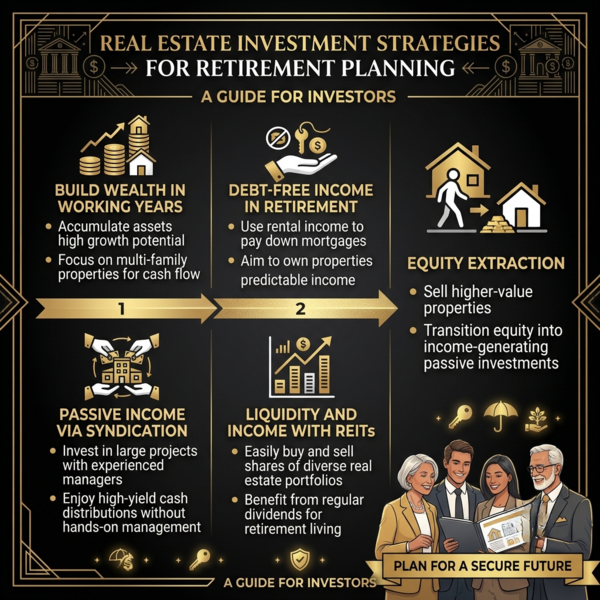
Retirement planning has traditionally revolved around paper assets: stocks, bonds, mutual funds, and annuities. While these conventional financial instruments remain core components of many wealth strategies, relying solely on volatile stock markets or historically low bond yields presents significant risks for modern retirees.
Real estate offers a powerful alternative or complement to standard retirement portfolios. By providing predictable cash flow, long-term equity growth, inflation resistance, and distinct tax advantages, real estate can serve as a steady foundation for financial independence in retirement.
Why Real Estate Belongs in Your Retirement Plan
Before diving into specific investment models, it is essential to understand why real estate stands out as a retirement vehicle:
- Predictable Monthly Cash Flow: Unlike stock dividends, which companies can alter or eliminate, rental income from well-located properties provides steady, recurring revenue to cover living expenses.
- Built-in Inflation Hedge: Rents and property values historically rise alongside or faster than inflation, preserving your purchasing power throughout retirement.
- Equity Buildup Through Leverage: Tenants pay down your mortgage debt over time, increasing your net worth without requiring continuous capital infusions from your primary salary.
- Tax Efficiency: Real estate offers powerful tax benefits, including property depreciation, expense deductions, 1031 exchanges, and tax-deferred growth through self-directed retirement accounts.
- Tangible Asset Control: Unlike shares of a public corporation, real estate gives you direct control over property improvements, lease terms, financing structures, and exit timing.
Key Real Estate Investment Strategies for Retirement
Different stages of life and risk tolerances require tailored real estate approaches. Below are six core strategies designed to help build, preserve, and harvest wealth for retirement.
1. The Classic Buy-and-Hold Residential Strategy
The buy-and-hold residential model involves purchasing single-family homes or small multi-family units (2 to 4 units) to generate monthly rental income while benefiting from gradual long-term property appreciation.
- How It Works: During your peak earning years, you acquire residential properties using conservative mortgages. Over a 15-to-30-year horizon, rental income covers mortgage payments, taxes, insurance, and maintenance. By the time you reach retirement age, the debt is paid off, leaving you with free-and-clear assets that generate net cash flow.
- Best For: Pre-retirees with a 10–30 year runway before retirement who want maximum control over their investments.
- Pro Tip: Focus on multi-family units (duplexes, triplexes, or quadplexes). They provide multiple income streams under one roof, lowering vacancy risk compared to single-family rentals.
2. Turnkey Real Estate Investing
For pre-retirees who want the benefits of residential real estate without the hassle of finding, renovating, or managing rental properties, turnkey investments present an attractive option.
- How It Works: Turnkey providers purchase distressed properties in strong economic markets, fully renovate them, place qualified tenants, and contract third-party property management. Investors purchase the fully operational property and immediately collect cash flow.
- Best For: Busy professionals or retirees looking for passive income without acting as active landlords.
- Key Consideration: Conduct strict due diligence on turnkey companies. Ensure property valuations reflect local market standards and that property management fees are factored into projected yields.
3. Real Estate Investment Trusts (REITs) and Real Estate Funds
If you prefer a 100% hands-off investment with high liquidity, Real Estate Investment Trusts (REITs) allow you to invest in large-scale real estate portfolios without owning physical property.
- How It Works: REITs are companies that own, operate, or finance income-generating real estate across sectors like residential apartments, healthcare facilities, industrial logistics, data centers, and commercial retail. Publicly traded REITs can be bought and sold like regular stocks.
- Key Retirement Advantage: IRS regulations require REITs to distribute at least 90% of their taxable income to shareholders as dividends, making them strong yield generators for retirement income.
- Best For: Retirees who want liquid exposure to commercial real estate with zero management obligations.
4. Real Estate Syndications & Private Equity
Real estate syndications allow individual investors to pool their capital with experienced professional real estate operators (sponsors) to acquire large, institutional-grade assets—such as 200-unit apartment complexes, self-storage facilities, or industrial parks.
- How It Works: As a passive investor (Limited Partner), you supply equity while the active sponsor (General Partner) handles acquisition, financing, asset management, and disposition. Investors receive regular cash distributions (typically quarterly) plus a share of profits upon sale or refinance.
- Best For: Accredited investors or high-net-worth pre-retirees looking for passive cash flow paired with significant depreciation tax benefits.
5. Short-Term and Mid-Term Rentals (Vacation Homes & Corporate Housing)
Short-Term Rentals (STRs) hosted on platforms like Airbnb or VRBO, as well as Mid-Term Rentals (MTRs) catering to traveling medical professionals or corporate relocations, can yield significantly higher gross income than traditional long-term leases.
- How It Works: Properties in desirable tourist destinations or near major medical centers are furnished and leased on a nightly, weekly, or monthly basis.
- Retirement Hybrid Model: Many pre-retirees purchase a vacation property in their target retirement location years in advance. They use STR/MTR rental income to cover the mortgage during their working years, then transition the property into their primary residence upon retirement.
- Key Consideration: Local regulations, short-term rental taxes, and management intensity are higher. Partnering with a dedicated hospitality management firm is crucial for retirees seeking passive income.
6. Downsizing & 1031 Tax-Deferred Exchanges
Your primary residence often represents a substantial portion of your total net worth. Transforming home equity into income-producing assets is a strategy used by many retirees.
- Equity Conversion: Selling a large family home after children move out allows retirees to purchase a smaller primary residence in a lower-cost area and invest the remaining equity into dividend-paying REITs, rental units, or syndications.
- 1031 Exchange: If you already own investment properties that have appreciated significantly but yield low cash returns, a Section 1031 exchange enables you to sell those properties and reinvest 100% of the proceeds into higher-yielding properties or consolidated multi-family assets without paying immediate capital gains tax.
Financial & Tax Strategies for Retirement Real Estate
                       ┌─────────────────────────┐
                       │  Acquisition Phase      │
                       │  • Moderate/High Debt   │
                       │  • Focus on Equity Growth│
                       └────────────┬────────────┘
                                    │
                                    ▼
                       ┌─────────────────────────┐
                       │  Stabilization Phase    │
                       │  • Debt Paydown         │
                       │  • Optimization         │
                       └────────────┬────────────┘
                                    │
                                    ▼
                       ┌─────────────────────────┐
                       │  Harvesting Phase       │
                       │  • Low/Zero Debt        │
                       │  • Maximum Net Income   │
                       └─────────────────────────┘
De-leveraging for Maximum Cash Flow
While mortgage leverage is your best tool during the growth phase, high debt levels introduce cash-flow volatility in retirement. A common strategy involves aggressive debt reduction in the 5 to 10 years leading up to retirement:
Net Cash Flow = Gross Rental Income – Operating Expenses + Debt Service
Eliminating debt service (Debt Service = 0) dramatically increases net monthly cash flow and lowers property break-even occupancy requirements.
Maximizing Tax Savings with Depreciation
Real estate allows investors to deduct a portion of the building’s value each year as an operating expense through depreciation (typically spread over 27.5 years for residential property). This accounting entry creates paper losses that shelter your real rental cash flow from income taxes.
Investing Through Self-Directed IRAs (SDIRAs) or Solo 401(k)s
Standard brokerage accounts limit retirement funds to traditional stocks and funds. With a Self-Directed IRA (SDIRA) or Solo 401(k), you can directly purchase physical real estate, private real estate funds, or trust deeds using tax-advantaged retirement funds. All rental income and capital gains return directly into your tax-deferred or tax-free (Roth) retirement account.
Risk Management for Retirees
To protect your retirement nest egg, implement strict risk-mitigation measures:
- Delegate Property Management: Acting as a landlord in your late 60s or 70s can lead to management burnout. Budget 8% to 12% of gross rental income for professional management.
- Maintain Capital Reserves: Set aside 3 to 6 months of operating expenses plus dedicated reserves for capital expenditures (roof replacements, HVAC units, plumbing) per property.
- Diversify Geographically: Avoid over-concentrating your real estate holdings in a single town or neighborhood vulnerable to local economic downturns or property tax hikes.
- Adequate Insurance: Maintain robust landlord insurance policies with umbrella liability protection to safeguard your personal net worth against legal claims.
Your Step-by-Step Retirement Roadmap
| Phase | Timeframe | Focus Strategy |
| Growth Phase | 15–30 Years to Retirement | Acquire properties using conservative leverage. Focus on long-term growth markets and total return. |
| Consolidation Phase | 5–10 Years to Retirement | Transition away from high-maintenance properties using 1031 exchanges. Accelerate debt paydown to maximize cash flow. |
| Harvest Phase | At Retirement | Collect passive cash distributions from debt-free properties, turnkey investments, syndications, and REITs. |
Conclusion
Real estate is one of the most reliable wealth-building engines for retirement planning. By combining direct property ownership, passive real estate investments, smart tax structures, and disciplined risk management, you can build a resilient portfolio that delivers steady income throughout your golden years.
Join The Discussion